The Millionaire Maker Investment Advisory
  • Introduction
  • Market Conditions
  • Commodities Corner
  • Featured Interview
  • Understanding Markets
  • Understanding Money
  • Understanding Value
  • The Tax Shelter
  • Retire Rich
  • Radio Blog
  • Contact

How To Collect 10.7% In Income From A Stock Yielding 1.2%

1/25/2014

4 Comments

 
Picture
Amber Hestla
MARKET CONDITIONS

I love Amber Hestla's no-nonsense approach to investing. She takes the complexities out of perceptions shared by both investors and brokers when it comes to achieving realistic gains in the market... particularly with Blue Chips. I sometimes get the puppy dog gaze when I tell people that if they aren't realizing at least 18% annually then something is wrong... and that's being very conservative! You don't need a lot of money... just a lot of "know how". A precise and commonsense approach as described below will help you achieve if not surpass 18% annually.

By Amber Hestla 
 
For 41 weeks in a row, the options trades I've recommended to my readers have been profitable. And on average, my readers are collecting 7.5% in "Instant Income" every 48 days. So far, we're 32 for 32 when it comes to closed trades. How am I doing it? It's actually pretty simple... but it requires some investors to leave their comfort zone. 

Options are one of the most misunderstood corners of the financial world. Many investors steer clear of options because they have a reputation for being risky, but that's not always the case.


My strategy involves selling options on undervalued stocks. And as we've mentioned selling "put" options is one of the most effective income strategies in the world. 

But today, I want to tell you about a different strategy -- selling covered calls.

A covered call strategy involves selling call options on stocks that you own. This allows you to generate income from selling options while benefitting from the potential upside by owning the stock. The downside risk is partly reduced by the income generated from selling options, which offsets potential losses in the stock. 

If you're a little confused by that, don't worry. An example of a trade you can make today should help clear things up. 

Aetna (NYSE: AET) is one of the largest health insurers in the nation. It is also a value stock that is trading with a price-to-earnings (P/E) ratio of about 13, about average for its industry. Despite the average valuation, AET is expected to grow faster than other large insurers, with earnings growth expected to average 10% a year over the next five years. 

As health insurance stays in the news, traders can be expected to look at companies like AET, and the stock could be volatile. That creates an opportunity for short-term gains. 

AET has recently traded around $67.75. Traders can buy 100 shares of AET and immediately sell a call option expiring in January with a strike price of $70 for about $1 per share, or $100 per contract, since each contract controls 100 shares. 

A call option gives the buyer the right to buy 100 shares of stock for a predetermined price (the strike price) at any time prior to the expiration date. Call sellers have an obligation to sell the shares if the buyer exercises their right to buy the stock, which they will do if the stock price is above the strike price when the option expires. 

In this case, if AET is above $70 when the call expires on Jan. 17, the buyer will exercise the option and you will have to sell your 100 shares at $70. Your profit on the trade will be equal to the difference in the sale price and the purchase price ($2.25 in this case) plus the option premium of $1 for a total of $3.25 per share. That would be a return of 4.8% in about two months, or 54 days to be exact. 

If AET is below $70 in January, you will have the opportunity to sell another call option and generate additional income. The current price of the option is about 1.4% of the stock's price. Selling an option for that amount every 54 days would generate income of about 9.5% a year. AET also pays a dividend for a yield of 1.2% a year. The combined income of 10.7% a year is almost nine times as much as owning the stock alone -- that's a 790% increase in income. And this income could offset any potential losses in AET. 

Covered calls, and options selling in general, are versatile strategies that can reduce risk, allow you to benefit from short-term market moves and generate income all at the same time. 

4 Comments

5 Sweet Energy Picks From T. Boone Pickens

1/25/2014

0 Comments

 
Picture
T. Boone Pickens
MARKET CONDITIONS

After graduating from Oklahoma State with a geology degree, T. Boone Pickens knew that energy was the sector for him. In his 60-year business career — first as a corporate raider, then as a legendary oil man — Pickens has become one of the most successful institutional managers focused on the oil and natural gas markets. Through various funds at BP Capital, T. Boone Pickens has amassed quite a fortune — estimated to be worth around $950 million — and has become an outspoken proponent of American energy independence.

When Boone talks, investors should listen.

While T. Boone Pickens is outspoken and appears regularly on financial television, the latest window into his thoughts comes from BP Capital’s latest 13F filing. Despite being dated for the end of the third quarter, the filing gives regular retail investors access to what the celebrated oilman is thinking. And that means grade-A stock ideas. Here are five of Pickens’ best-looking holdings.


#1.
Picture
Exxon MobilIt seems that Warren Buffett isn’t the only one seeing the value in integrated oil giant Exxon Mobil’s (XOM). Through the third quarter, T. Boone Pickens initiated a new $6.77 million position in Exxon, making XOM stock the second-largest holding in BP Capital’s portfolio. It’s easy to see why Pickens would want to “put a tiger in his tank.”

After suffering under dwindling production, XOM has trailed its peers like Chevron (CVX) in the returns department. However, this past quarter, Exxon finally saw its critical production numbers increase. And with a slate of new projects coming online in the next few years, that trend should continue. Meanwhile, the integrated giant continues to mint cash flows — which it has been graciously giving back to shareholders via hefty buybacks and dividends.

Yet, at just 12x forward earnings, XOM shares are one of cheapest options in the energy sector, not to mention the broader stock market.

Given its growth profile, leadership position, and propensity to produce billions in cash flows, investors should be seriously looking at this “reasonably-priced high-quality bond” with both eyes open. Following Pickens’ lead could result in big returns over the long haul.

#2.

Picture
T. Boone Pickens continues to be ecstatic over the hydraulic fracking boom and shale oil/natural gas. As such, many of his stock picks play into shale production growth. One of the newest is a $3.4 million position in E&P firm EQT Corporation (EQT).

EQT produces natural gas and related natural gas liquids (NGLs) from the Appalachian Basin, better known as the prolific Marcellus Shale. The firm owns roughly 560,000 acres in the Marcellus alone and has 14,000 productive wells in the entire basin.

Those generously producing wells have helped EQT report some stellar earnings over the last few quarters. Its third-quarter adjusted earnings came in at 58 cents per share — more than double the amount earned from the same period last year. Aside from production gains at EQT, the firm has benefited from its “drop-down” relationship with its pipeline subsidiary EQT Midstream (EQM). That has relationship has provided plenty of tax-friendly distributions back into EQT’s bottom line.

While it isn’t the cheapest stock, EQT shares do represent one of the major leaders in the Marcellus. It’s no wonder why Pickens loaded up.


#3.

Picture
When private equity firm Apollo Global Management (APO) started selling, Pickens started buying. Pickens has added 150,000 shares of Athlon Energy (ATHL) since it went public back in the beginning of August — a value of $4.4 million.

The mid-cap producer focuses its activities oil and liquids-rich natural gas reserves in the Permian Basin. That strategy has suited the new company well, as regional production and higher oil prices have helped ATHL trounce earnings estimates for two consecutive quarters. For the latest quarter, Athlon managed to realize a 109% increase in adjusted earnings as well as see a 69% increase in daily production volumes.

Since going public, ATHL has gone straight up and has returned a staggering 60% for investors who bought in at the IPO price of $20.

But given the awesome production and earnings gains that ATHL has already put in, it’s safe to say that there’s plenty opportunity for more as the company matures. For investors like Pickens, that could mean a lot of money.

#4.

Picture
Everyone loves a turnaround story. For T. Boone Pickens and BP Capital, that story happens to be oil service firm Weatherford International (WFT). Pickens increased the size of his position by 44% during the past three months.

The smallest of the big four oil service stocks, Weatherford has been rocked by an accounting investigation — going back six years — and major debt issues. Those problems have caused WFT to trail behind several of its rivals — both big and small.

However, things could finally be looking up for WFT. The firm recently settled those nasty accounting issues and has gotten serious about cost controls to remove its $9 billion worth of IOUs. At the same time, WFT is exploring options for land drilling rig business unit. As drilling has gotten more efficient, the number of drilling rigs focused on land are piling up. That has caused the business unit to be a huge drag on WFT’s earnings over the years. One solution being proposed by Weatherford is to spin off the business via an IPO. All in all, these moves could finally put some spark back into WFT shares.


#5.

Picture
Dwindling crack spreads over the last two quarters have hurt the refiner’s margins — including industry stalwart Valero Energy (VLO). Sensing a bargain, T. Boone Pickens increased his stake in the nation’s largest independent downstream firm by 163%, adding another $2 million to his position.

That could be a smart move now that things are getting better at VLO.

First, those crack spreads are beginning to widen once again. The sheer amount of oil production is overflowing storage depots and is causing West Texas Intermediate prices to fall versus international standard Brent. That price difference means that margins will be on the uptick at VLO once again. Even more so as Valero has moved to exporting gasoline and other refined products in spades.

Then there is the firm’s pending midstream IPO to consider. The new MLP subsidiary will help VLO realize huge benefits and tax-deferred distributions once it gets cooking.

With a forward P/E of less than 10, investors are getting a huge deal on VLO shares — especially when considering its story is on the uptick. Following Pickens’ lead into Valero could be one of the best plays of the New Year.


0 Comments

The 5 Best Vanguard Funds to Buy Now

1/25/2014

2 Comments

 
Picture
MARKET CONDITIONS

There’s no big secret behind the success of Vanguard funds — investor assets flock to Vanguard thanks to the company’s dedication to straightforward investing and low-cost products.
Don't just get Vanguard's low costs — get high quality, too.


Vanguard Total Stock Market Index (VTSMX) recently became the largest mutual fund in the world — helped in large part by a rotation out of bonds and into stocks over the past few months. However, you can bet investors were drawn to the Vanguard fund over other products thanks to its bare-bones 0.17% expense ratio, too.

The simple truth is that most mutual fund companies exist to make a profit for themselves as well as investors. However, Vanguard’s structure is unique and allows it to basically offer its products at a price that reflects the cost of doing business — without showing a profit.

Investors benefit as all mutual funds are offered as no-load products, with no marketing or distribution fees charged to investors, and the funds in general tend to have low overall expense ratios.

But low cost isn’t all that Vanguard funds have going for them — Vanguard provides quality, too. Here, we look at some of the most compelling offerings of this industry giant:

#1.
Picture
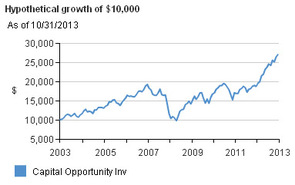
Vanguard Capital Opportunity (VHCOX)
represents a fine second chance for investors to access a great stock-picking team.

VHCOX was reopened this year to new investors who invest directly with Vanguard and features a low-turnover approach to growth-stock investing.

Managed by Pasadena-based PrimeCap, this Vanguard fund has changed over time, morphing from a midcap fund into a large-cap offering over the years. Still, the results have been solid, with the fund up 38% YTD and up 11% annually over the past decade, placing it in the top 4% of its Morningstar category and attracting $11 billion in assets.

As is typical with other PrimeCap products, healthcare names are prominent and represent 37% of the 123-stock portfolio, while technology holdings account for 34%. Recent top holdings include Biogen (BIIB), Amgen (AMGN), Roche (RHHBY), FedEx (FDX) and Eli Lilly(LLY).

VHCOX charges just 0.48% annually, or $48 for every $10,000 invested, and a low 9% turnover also helps minimize drag on the fund’s returns.


#2.

Picture
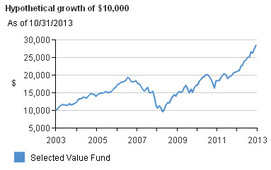
Vanguard Selected Value (VASVX) is dedicated to finding undervalued companies in the midcap space that have upside potential over time. Vanguard uses two managers on this fund, and with fine results. Barrow, Hanley, Mewhinney & Strauss LLC manage the bulk of assets with the firm of Donald Smith & Co. Inc. also contributing to the team.

The combination has led VASVX to 37% returns this year, and over the past 10 years, this $7 billion Vanguard fund has gained an annualized a little more than 11%, placing it in the top 6% of its Morningstar peer group.

As I have stated before, Wall Street doesn’t follow most medium-sized firms with the same intensity that they analyze larger, better-known stocks. This creates opportunity for stock-pickers and investors.

VASVX is a relatively focused portfolio that consists of just 66 stocks at present, including top holdings Royal Caribbean (RCL), Micron (MU), Omnicare (OCR), Cardinal Health (CAH) and Hanesbrands (HBI). Vanguard Selected Value charges just 0.38% in annual expenses.


#3.

Picture
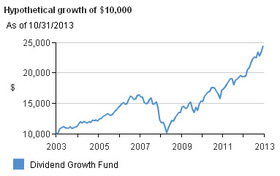
Vanguard Dividend Growth (VDIGX) is a fund that focuses squarely on solid firms that have the “ability and willingness” to grow dividends over time.

This $18.3 billion fund has been managed by Don Kilbride of Boston-based Wellington management since 2006. His style of investing is to focus on firms that are fundamentally solid businesses — not necessarily firms that simply pay outsized dividends. This leads him to companies that are growing at a moderate pace while throwing off some income for investors while they wait. These firms tend to hold up relatively well in a downturn — this fund lost 26.6% in 2008 compared to a 37% plunge for the S&P 500 that year.

Healthcare accounts for 20% of VDIGX’s 52 holdings, and consumer discretionary names take up another 17%. Mr. Kilbride prefers to own a focused group of large-cap stocks, leading to top holdings such as UPS (UPS), McDonald’s (MCD), Microsoft (MSFT), Walmart (WMT) and Cardinal Health.

VDIGX is up 29.2% YTD, and has returned an annualized 9.7% during the past decade. This performance places it in the top 4% of its Morningstar large blend category. Expenses for this Vanguard fund are 0.29%.

#4.


Picture
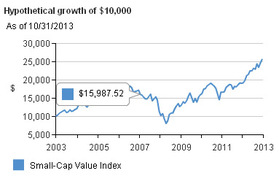
Vanguard is a fund family that consistently promotes the value of its index fund offerings. However, while Vanguard Small-Cap Value Index (VISVX) is one of its lesser-known options, it continues to post solid results.

This Vanguard fund seeks out undervalued, out-of-favor names in the small-cap world; it currently holds more than 800 companies. VISVX is dedicated in large part to financials, which account for 29% of the portfolio. Clearly this fund is a good way to play the continuing recovery in this sector.

Recent top holdings include Towers Watson (TW), Genworth Financial (GNW), Hanesbrands, Jarden Corp. (JAH) and Fidelity National Financial (FNF).

VISVX is up 32% so far in 2013, and has appreciated by an annualized 10% over the past decade. As an added and unexpected bonus, VISVX pays some dividend income, to the tune of 1.9% over the trailing 12 months.

The fund has a reasonable $3,000 minimum to get started, and the same goes for VHCOX, VASVX and VDIGX. Expenses are just 0.24% annually.

#5.

Picture
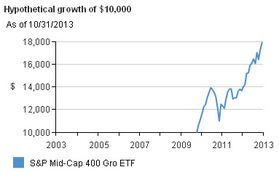
For investors that prefer an ETF platform, Vanguard Mid-Cap 400 Growth ETF (IVOG) is a compelling option featuring dynamic stocks in medium-sized companies.

IVOG, which tracks the S&P MidCap 400 Growth Index, is made up of more than 200 high-growth names including Alliance Data Systems (ADS), Affiliated Managers Group (AMG), Tractor Supply  (TSCO), LKQ Corp. (LKQ) and HollyFrontier (HFC).

This product is a fairly new Vanguard offering, garnering just $261 million in assets, yet results have been strong. While IVOG is tracking the market at roughly 27% year-to-date, it has returned 16.3% annualized over the past three years, placing it in the top 28% of its Morningstar category. Expenses run a low 0.2%.


2 Comments

Collect An 8.6% Yield... Every 48 Days

12/2/2013

0 Comments

 
Picture
Amber Hestla
MARKET CONDITIONS


"Always be in a position to trade another day."

Those were some words of advice John Bollinger gave Amber Hestla as they sat around the dinner table at Ted's Montana Grill in Denver two weeks ago.

John, like Amber, has made a career out of trading options. It was his initial work with options back in the 1980s that lead him to develop the Bollinger Band (R), a technical indicator used by analysts the world over to identify when an asset may be overbought or oversold.

Given his contributions to the profession and his accomplishments as a trader, it's safe to say John has had considerable success navigating the options market. So when Amber asked him what the key to that success has been, she wasn't surprised to hear his answer: "Always be in a position to trade another day."


As any good trader or investor knows, you should always have capital preservation in mind when taking a position -- especially when it comes to options.

According to our research, nearly 80% of people who buy options lose money in the process. With those kinds of statistics, it's not hard to see how some options traders can turn a large fortune into a small one in no time flat.

But just because the odds are against you, it doesn't mean you can't safely make money in the options market.

Since Amber launched her premium newsletter, all 25 of her closed trades have been profitable, giving her and her subscribers an average gain of 8.6% every 48 days. What's been the key to her success?

For one, Amber insists on selling options, not buying them. Since 80% of options buyers are losers, it stands to reason that 80% of options sellers must be winners. By limiting herself to selling options, she is significantly stacking the odds in her favor.

But Amber also has another defense mechanism, and it's similar to one that Bollinger has used throughout his 40-year investing career: "I only take trades that offer a high margin of safety."

If you have ever read anything published by Amber, you've likely heard that phrase before. That's because she puts safety at the forefront of every one of her recommendations. In fact, for her to even consider taking a position, it must have a "margin of safety" of at least 70%.

With her put selling strategy, Amber only sells put options with at least a 70% chance of expiring worthless. When a put expires worthless, the seller gets to keep the premium they collected from selling the option as pure profit.

Additionally, she only sells puts on stocks she thinks are undervalued. The more undervalued the stock is, the less likely shares are to descend below her recommended strike price, at which point the option is no longer profitable.

Let me show you an example.

In July, Amber recommended selling puts on Humana (NYSE:HUM), the nation's second-largest provider of Medicare benefits.

At the time, the stock was trading at $83 a share. Amber thought the company's fundamentals supported a higher price point. As she told her readers:

"Right now, [Humana's] price-to-earnings (P/E) ratio of 9.7 is well below the insurance industry average of 14.1.

"And in addition to the low P/E ratio, HUM has historically enjoyed a better-than-average return on equity and less debt as a percentage of equity than its competitors. These ratios indicate that HUM is a well-managed company that should be able to navigate upcoming changes in the industry.

"If the most pessimistic analyst is correct, HUM is still a buy. The average P/E ratio over the past seven years for insurance stocks is 12.2. Using that ratio and the lowest EPS estimate of $7.85 for 2014, HUM should be worth at least $95."

In other words, at $83 a share, Amber thought the company was undervalued by 14.5%. As a result, she told her Income Trader subscribers to sell August puts on Humana with a $75 strike for about $0.85 per share, or $85 per contract. Given the company's strong fundamentals and discounted valuation, Amber believed there was an 83% chance that the price of the stock would not trade below $75 by Aug. 16 -- the day the option expired -- and that the put would expire worthless.

Her assessment was spot on. In the two-month period the trade was open, Humana gained 10% -- closing above $91 a share on Aug. 16. As a result, Amber got to keep the $85 in Instant Income she collected from selling the puts as a pure profit.

But even if the stock had fallen below the strike price and Amber had been put the shares, she would only have to purchase them for $75 -- $20 below what she thought they were worth in the long run.

That's the benefit of selling puts on stocks that you think are undervalued. Even if the price of the underlying stock falls below the strike price and you have to buy the stock, you're simply buying shares of a great company that you already think is trading at a discounted valuation.

In my opinion, this conservative approach is the key to being a successful options trader. By limiting your trades to those with only the highest margin of safety, you're able to take advantage of the lucrative nature of the options market, while also reducing risk substantially.

Of course, restricting yourself to "high-probability" positions means you could miss out on big gains in other riskier corners of the market. But for Amber, that's not a problem. After all, her goal is to generate safe, reliable income. While that means she may miss out on some trades with "10-bagger" potential, at least she's comfortable knowing she'll be around to "trade another day."
0 Comments

The Scoop On Penny Stocks

12/2/2013

0 Comments

 
Picture
MARKET CONDITIONS

I have made money on penny stocks and currently am holding several in my portfolio. The trick is knowing when to get in and definitely when to get out.
I have learned the hard way of course that anything hyped up usually is nothing but just that... hype! It's the hidden gems that deliver stellar returns that hardly get noticed at least not by the investors who follow hyped up trends. Do your research and look down the road to see if the penny stock you're eyeing has a future longer than 6 months.

Two of the biggest motivating factors in the world are the emotions of fear and greed. Fear can keep investors from investing at all or cloud their judgment and cause them to panic and sell a stock at the wrong time.

Greed, on the other hand, causes investors to take undue risks. They margin their stocks heavily or they chase lofty stocks that are already trading at insane valuations because it seems that "everyone" is in the stock and they don't want to get left behind.

But then there's another common mistake that investors make that is due to greed. It's investing in penny stocks. These are stocks that are generally priced under $1 per share.

Penny stocks initially seem so enticing. You can get a gazillion shares even with a small amount of money. So you feel like you own a lot of it. Secondly, a small move higher is a huge percentage move upward and can cause a huge gain, profit-wise.

So what's the problem with that? There are a few major reasons why penny stocks rarely pan out and produce the great gains that people tout.

For starters, penny stocks have wide spreads and tend to have low volume. The spread is the difference between the price at which you can buy the stock and the price at which you can sell the stock. The buy price is always much higher than the sell price is. So even with a large gain, much of the gain consists of just getting the selling price of the stock up to the buy price level or better. And this doesn't even factor in your commission costs.

So the selling price of the stock has to climb a long ways to get above the buy price and high enough to overcome the commission costs too in order to become profitable.

With the typical stock out there, these spread costs are fairly low and the price doesn't have to move much to put the sell price greater than your buy price is. But that's not generally the case with penny stocks.

Additionally, these tend to be lower-volume stocks. So your fills can be slow and at various price points that are unfavorable to you.

The low-volume nature of penny stocks also makes penny stocks a favorite of scammers who love to "pump and dump" the stock. By that, I mean that they get up a huge following through email lists or some other communication venue (Twitter, etc.). They buy the stock, then tell their ton of followers to do the same. These other investors end up pushing up the stock price for the scammer and the scammer gets out with a nice profit while your price generally never made it up high enough to produce a nice profit. In other words, they used you for a profit. They "pumped up the stock" and then "dumped" it.

A penny stock is more easily controlled due to its low trading volume. You see, if someone buys 10,000 shares of a 50 cent stock that trades 20,000 shares in a day, they're going to move that stock price considerably and be able to manipulate the price for their advantage.

Had they been in a stock that trades millions of shares a day at a higher price point, they'd not likely be able to do this. So that's why the scammers love penny stocks. And that's one reason why you should not love them. You're typically on the late end of the trade they tell you about.

The next great reason to stay away from penny stocks is because most large institutions are barred from investing in stocks under $5 per share and some are even stricter and won't allow investing in a stock under $10 per share.

The problem is that all of the "big money" can't get into the stock and, therefore, a larger sustainable push higher in the stock is not likely to happen with the "big boys" being out of the game.

In other words, imagine telling most every mutual fund, pension fund, etc. out there that they can't invest in a stock. That's what you have when you have penny stock investing. There isn't the proper volume in a penny stock for these funds to invest. Yet it's these huge funds investing over time that is needed to cause a real, sustainable rise in a stock. That element is totally absent in penny stock investing. Yet it's totally present in stocks above $5 to $10 per share.

A prime example of this is a stock that I invested in some months back. Then a month or so ago, a billionaire investor invested $1.5 billion into the stock. Well, what did it do? It pushed my shares up quite a bit upon this huge investor investing and upon others hearing that he invested and they invested as a result. So the huge volume of buying that came propelled the shares that I owned much higher. This is what you want to have happen. You want large institutions to have the ability to invest their money in stocks that you are in. The penny stock investor doesn't have that luxury.

So I hope what you get out of this is that the penny stock investor has a ton of things going against them that the typical stock investor doesn't have going against them. I hope you see penny stocks aren't as glorious and as much "easy money" as people make them out to be.

Therefore, the next time your buddy tries to get you to buy a penny stock or you get an email that is pushing a penny stock, I hope you'll remember what I'm teaching you today and you'll avoid a huge pitfall.
0 Comments

Upgrades and Downgrades

12/2/2013

0 Comments

 
Picture
MARKET CONDITIONS


Upgrades
  • Pearson (PSO) upgraded by BofA/Merrill from Neutral to Buy
  • easyJet (ESYJY) upgraded by HSBC from Underweight to Neutral
  • Best Buy (BBY) upgraded by Citigroup from Neutral to Buy
  • ONEOK Partners (OKS) upgraded by Goldman from Sell to Neutral
  • Layne Christensen (LAYN) upgraded by UBS from Sell to Neutral
  • priceline.com (PCLN) upgraded by Goldman from Buy to Conviction Buy
  • Cabot Oil & Gas (COG) upgraded by Bernstein from Market Perform to Outperform
  • Teva (TEVA) upgraded by Susquehanna from Neutral to Positive
  • Layne Christensen (LAYN) upgraded by UBS from Sell to Neutral
Downgrades
  • Danske Bank (DNSKY) downgraded by Societe Generale from Hold to Sell
  • Deutsche Post (DPSGY) downgraded by BofA/Merrill from Buy to Neutral
  • C.H. Robinson (CHRW) downgraded by Deutsche Bank from Buy to Hold
  • ANA Holdings (ALNPY) downgraded by Citigroup from Buy to Neutral
  • Patterson Companies (PDCO) downgraded by UBS from Buy to Neutral
  • Dick’s Sporting (DKS) downgraded by BMO Capital from Market Perform to Underperform
  • Boeing (BA) downgraded by Oppenheimer from Outperform to Perform
  • WhiteHorse Finance (WHF) downgraded by Wunderlich from Buy to Hold
  • Twitter (TWTR,FB) downgraded by Cantor from Buy to Hold
  • Medtronic (MDT) downgraded by Argus from Buy to Hold
  • Consolidated Edison (ED) downgraded by Argus from Buy to Hold
0 Comments

The Toll Road To Success

12/2/2013

0 Comments

 
Picture
MARKET CONDITIONS


PROFILED: Brookfield Infrastructure (NYSE:BIP)

Hoover Dam (originally called Boulder Dam) was finished in 1936, at which point it began damming the Colorado River to create Lake Mead -- the United States' largest reservoir.

The project was massive. At its peak, more than 5,000 people worked on it at the same time. And the dam contains enough concrete to pave a two-lane highway from San Francisco to New York City.
In total, construction costs came to $49 million.

That $49 million investment is the sole reason why millions of people are able to live in the Las Vegas area today. And it has generated billions of dollars of wealth in the process.

But Hoover Dam didn't just create a massive reservoir to provide water to the middle of the desert. It also created one of the most lucrative electricity generation plants ever built.

Located in the base of the dam are 17 hydroelectric turbines that make up the Hoover Powerplant. These turbines generate roughly 4.2 billion kilowatt hours (kWh) of electricity per year, making it one of the largest hydroelectric plants in the United States.

Electric providers love hydroelectric power because it's among the cheapest power sources on the planet. Hoover Powerplant sells its electricity on the wholesale market at just 1.6 cents per kilowatt hour. In comparison, Las Vegas residents pay an average of 11.6 cents per kWh for electricity -- seven times as much.

But even at that low cost, Hoover Dam generates and sells about $63 million in electricity every year (1.6 cents x 4.2 billion kWh) -- that's nearly 130% of what it cost to build the dam in the first place.

Of course, there are a number of other costs such as maintenance and upkeep that figure into the equation, but the point remains -- Hoover Dam has become one of the greatest individual investments ever made by the U.S. government. And it continues to increase its return year after year.

So how can this help us as investors? After all, as I mentioned earlier, you can't invest directly in Hoover Dam.

You simply have to understand why Hoover Dam has been such a success...

Hoover Dam is what I like to call an "irreplaceable asset."

No one can come along and build a competing dam. And the world isn't going to run out of a need for electricity. If anything, we'll need more electricity in the future.

That's why even 76 years after it was built, the dam is more important today than ever.

And while you can't invest in Hoover Dam, there are dozens of irreplaceable assets around the world -- including many hydroelectric dams -- that you can invest in.

And as you would expect, investing in these irreplaceable assets has proven to be extremely profitable.

Take oil and gas pipelines, for example. Pipelines are the ultimate irreplaceable assets. Another company can't simply build a pipeline next to an existing one. And the pipelines that carry fuel, natural gas, oil, and other commodities across the country aren't about to be replaced by some new technology.

That's why I've loaded up on pipeline operators, which are typically structured as master limited partnerships (MLPs), in my Top 10 Stocks portfolio.

In fact, pipelines have been one of the strongest corners of the market for years. The benchmark for master limited partnerships -- the Alerian MLP Index -- has returned 328%, including dividends, during the past decade... or almost 16% a year. That's over three times the S&P 500's 10-year performance.

But there are more irreplaceable assets than just pipelines.

Take my investment in Brookfield Infrastructure (NYSE:BIP). Brookfield owns toll roads, electricity transmission grids, ports, and railroads all over the globe. All of these are irreplaceable assets. And they continue to earn a steady stream of cash for BIP and its investors.

This is exactly why I added the shares to my portfolio more than two years ago. And it's why the stock is one of my biggest winners -- up 67% in just over two years while paying a yield of 4.4%.

Don't get me wrong, there are no guaranteed winners in the investing world. Any investment can fall in value. But when you find the sort of securities that give you access to irreplaceable assets, they often end up being some of the most lucrative investments to own for the long term.
0 Comments

This Trade Could Make a Potential 233% Profit in 14 Months

11/30/2013

0 Comments

 
Picture
MARKET CONDITIONS


         PROFILE:
CurrencyShares Australian Dollar Trust (NYSE: FXA)

By Alan Knuckman, Profitable Trading


The proximity of resource-rich Australia to China makes it an important barometer for the strength of the Chinese economy. Australian dollars were even held as a bullish play on China until the renminbi was liberalized.

The Aussie dollar just hit a fresh two-month low on Monday following Federal Reserve taper talk, but the currency has been sliding for the past week after reports that Chinese manufacturing expanded at a slower pace.

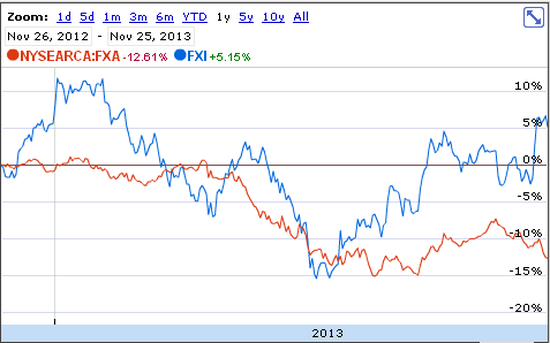
The very strong correlation between the CurrencyShares Australian Dollar Trust (NYSE: FXA) and iShares China Large-Cap (NYSE: FXI) over the past five years has weakened recently. In the past 52 weeks, FXA is off 11% with FXI up 8%.

Picture
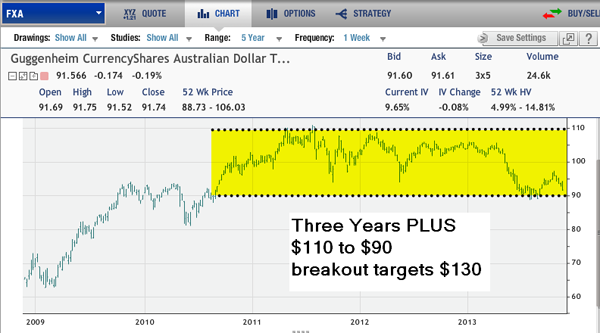
FXA has traded in a $20 range between $90 and $110 for more than three years. At present, it has once again retraced to key support at the bottom of the range. The first upside target is a move to the top of the channel at $110, and a breakout above it could eventually lead to a move to $130.
Picture
The $110 target is about 20% higher than recent prices, but traders who use a capital-preserving, stock substitution strategy could see a 200%-plus return on a move to that level. One major advantage of using a long call option rather than buying a stock outright is putting up much less capital to control 100 shares — that’s the power of leverage.

But with all of the potential strike and expiration combinations, choosing an option can be a daunting task.
You want to buy a high-probability option that has enough time to be right, so there are two rules traders should follow:

Rule One: Choose a call option with a delta of 70 or above.
An option’s strike price is the level at which the options buyer has the right to purchase the underlying stock or ETF without any obligation to do so.

(In reality, you rarely convert the option into shares, but rather simply sell back the option you bought to exit the trade for a gain or loss.)

It is important to buy options that pay off from a modest price move in the underlying stock or ETF rather than those that only make money on the infrequent price explosion. In-the-money options are more expensive, but they’re worth it, as your chances of success are mathematically superior to buying cheap, out-of-the-money options that rarely pay off.

The options Greek delta approximates the odds that an option will be in the money at expiration. It is a measurement of how well an option follows the movement in the underlying security. You can find an option’s delta using an options calculator, such as the one offered by the CBOE.

With FXA trading near $91.75 at the time of this writing, an in-the-money $85 strike call option currently has about $6.75 in real or intrinsic value. The remainder of the premium is the time value of the option. And this call option currently has a delta of about 76.

Rule Two: Buy more time until expiration than you may need — at least three to six months — for the trade to develop.

Time is an investor’s greatest asset when you have completely limited the exposure risks. Traders often do not buy enough time for the trade to achieve profitable results. Nothing is more frustrating than being right about a move only after the option has expired.

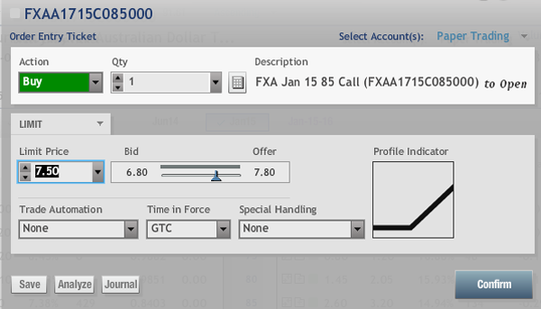
With these rules in mind, I would recommend the FXA Jan 2015 85 Calls at $7.50 or less.

Picture
A close below $90 in FXA on a weekly basis or the loss of half of the option’s premium would trigger an exit. If you do not use a stop, the maximum loss is still limited to the $750 or less paid per option contract. The upside, on the other hand, is unlimited. And the January 2015 options give the bull trend over a year to develop.

This trade breaks even at $92.50 ($85 strike plus $7.50 options premium). That is less than $1 away from FXA’s recent price. If shares hit the $110 target, then the call option would have $25 of intrinsic value and deliver a gain of more than 200%.

Recommended Trade Setup:

– Buy CurrencyShares Australian Dollar Trust (NYSE: FXA) Jan 2015 85 Calls at $7.50 or less
– Set stop-loss at $3.75
– Set initial price target at $25 for a potential 233% gain in 14 months

0 Comments

This High-Yield Stock Is A “Strong Sell

11/30/2013

0 Comments

 
Picture
MARKET CONDITIONS

A lot of the REITS particularly the mortgage REITS are in trouble. The earnings are sliding not because business is bad but because borrowing money has become expensive. The banks have raised their rates and the equity and hedge funds aren't refinancing debt any longer. The REITS cannot borrow enough to make new deals or get better options on their CMOs. A lot of their portfolios are made up of long-term yields which are good for dividends but as rates rise so does the NOI and eventually dividends will be the first area of cuts.

By Eric Dutram, Zacks Investment Research


Mortgage REITs (mREIT for short) have long been favorites of dividend investors, and especially before taper concerns came back into the picture. Securities in this space often pay double digit yields, and with such a sluggish market for income, these were preferred picks by many.

The structure of mREITs also increased their appeal when rates were stable. That is because mREITs generally borrow at short-term rates and then invest in longer term securities. So in this strategy, a big spread between short term and long term rates is key for strength in their business model.

However, as taper talk has resumed the spread has shrunk between these two key figures, while there is a threat of further compression in the weeks and months ahead as well. This has been terrible news for the space and many have jumped out of stocks in this corner of the market as a result.

In particular, one to watch for further losses is American Capital Agency Corp (AGNC).

AGNC’s Recent Earnings
The latest earnings report for AGNC was pretty terrible by any estimation. Third quarter results came in at 61 cents a share, falling well short of the consensus estimate of 84 cents a share. Results also represented a decline sequentially too, as last quarter saw 66 cents of earnings, while the year ago period saw 79 cents a share.

Especially concerning from the report was the average yield on its agency security portfolio, which slumped by 33 basis points down to just 2.59%. Meanwhile, its cost of funds which was more or less stable—down just four basis points—to 1.39%. This means that the interest rate spread declined by 29 basis points to just 1.20%, eating into the company’s profits and future prospects as well.

Live by the dividend, Die by the dividend
Dividends, one of the main reasons to buy a mortgage REIT, have also been on the decline for AGNC. The firm’s Q3 dividend came in at 80 cents a share, a nearly 24% decline from the previous quarter, and when annualized, a huge drop from previous years.

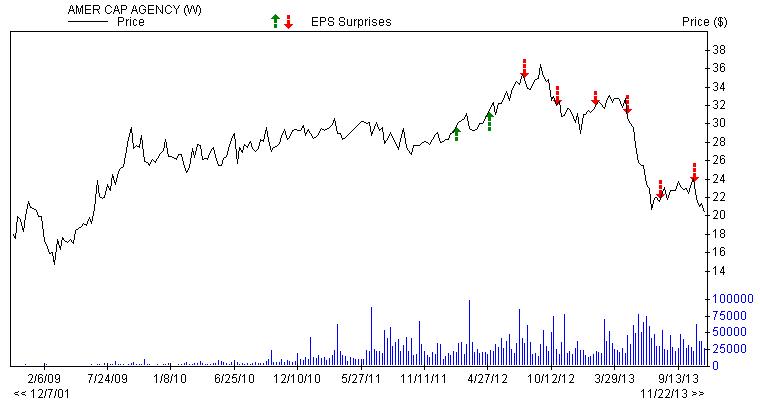
Thanks to declining margins and slumping yields, investors have sold off AGNC in droves. Shares of the company are down more than 30% YTD, and the stock is within striking distance of its 52 week low as well.

Estimates are falling too
And based on the latest earnings report and the sluggish trend in the interest rate market, many analysts seem to believe that the slump isn’t over for AGNC. In fact, analysts have been slashing their forward estimates for AGNC to the bone as of late, suggesting that more pain is on the way.

The magnitude of these revisions has been colossal too, with estimates for the current year falling from $6.92/share 30 days ago to just $4.37/share today. Next year figures are also depressing, with estimates falling from $3.26/share 30 days ago to just $2.60/share today, representing a decline of over 20%.

Due to these factors, and a horrendous history at earnings season—four straight misses of at least 11%– we have no choice but to assign AGNC a dreaded Zacks Rank #5 (Strong Sell). So we are looking for more underperformance from this struggling company to close out the year, and especially so if the interest rate spread compresses even more in the coming months.

Picture
Other Options
Unfortunately, the mREIT industry has a terrible industry rank, coming in at just 229 out of 260, putting it near the bottom 10%. Yet despite this poor rank, there is one company that appears well-positioned in the space and could actually be a decent pick; Ellington Residential (EARN).

This company has a Zacks Rank #1 (Strong Buy) and this actually represents an increase from a week ago when the stock had a Rank of 3. The firm also saw a strong surprise in the previous earnings release, and solid estimate revisions higher too.

So if you are looking to stay in the mREIT space, consider going a little smaller and focusing on EARN. This company has a double digit yield and it could be better positioned than the struggling AGNC at this time.

0 Comments

Insiders Are Buying Up These 7 High-Yield Stocks -- Should You?

11/30/2013

0 Comments

 
Picture
One thing rich people like is to stay rich. With that being said, a lot of "gossip" is thrown around at country clubs and exclusive parties.
MARKET CONDITIONS

Some moves are made and the rest of the elite flock follow. People who aren't rich need to be in-tuned with CEO and investor gurus that go on shopping sprees for stock.

You don't need a lot of money to get started; just follow the rich guy's lead. You repeat the process more than several times and eventually, there will be a pot of gold at the end of the rainbow.

By Nathan Slaughter 
  

They say to never trust a skinny cook, the logic being that any chef who works in a kitchen all day and creates irresistible dishes probably can't help but overindulge and pack on a few pounds.

For much the same reason, I find it reassuring when a mutual fund manager invests their personal cash in his or her own fund. And I like it even better when CEOs and other top executives stash a sizable percentage of their net worth in their own company's stock.

Conventional wisdom says that it's a bullish sign when a company invests in itself through stock buybacks. If that's true (and in most cases it is), then what does it say when these same managers sink a few million dollars of their OWN money in the shares?

After all, board members, directors, chairmen and other upper executives know the business and the industry better than anyone else. Who understands the inner workings of Apple (Nasdaq: APPL) better than Tim Cook? Who has their finger on the pulse of online advertising quite like Google boss Larry Page?

These well-connected individuals also have access to privileged information that the rest of us don't get to see. That's not to insinuate anything underhanded; public companies don't have to disclose everything. The point is, when these people act, they do so with good authority.

Personally, I don't pay terribly much attention to insider sales. Can they be an indication of trouble ahead? Sure. But they could also mean that the seller is simply diversifying his holdings or raising cash to pay for his daughter's wedding or grandson's college education. Bottom line, sales aren't necessarily a red flag.

On the other hand, insider purchases tend to be far more instructive. You only invest in a stock for one reason: you believe it's undervalued and headed higher. And again, when a chairman or CFO is the one buying, you can bet they aren't doing it on a whim -- but have sound supporting evidence.

The numbers back this up. There have been numerous empirical studies done over the years to quantify the effect.

A recent study at the University of Illinois found that stocks receiving heavy insider support historically outperform the market by 4.8% in the year following the transactions.

These and other studies examined different groups of stocks under different methodologies. But taken together, they do point to the same conclusion: Stepped-up levels of insider buying often foreshadow market-beating returns.

If one inside buyer is a positive show of confidence, then two or three (or more) all buying in unison sends an even louder message.

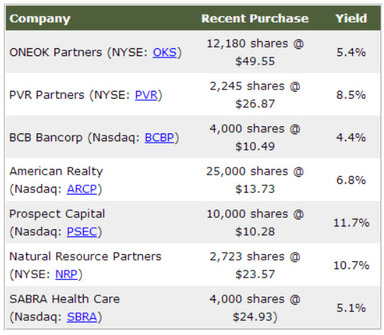
With all this in mind, I went in search of stocks that had strong levels of insider ownership relative to the overall share count. And since I'm more interested with insider buying activity that has taken place over the past few weeks or months in anticipation of an upward move or positive catalyst, I screened for stocks whose insider buying volume through the third quarter had shown the biggest surge relative to the same point last year. To tighten up the results, I also looked for companies with steady earnings prospects and, of course, generous current yields (4% or better).

Here are some of the more notable stocks that made the cut.

Picture
When sifting through the results of this screen, a few things became obvious.

There are quite a few midstream energy companies on the list, including one holding I recommended previously in my High-Yielding Investing advisory. Even better, readers were able to pick up the stock at an even cheaper price -- and well before the CEO bought shares on August 9.

The regional banking sector was also well represented. But insiders appeared to be most enamored with private equity and business development stocks. Could that mean that the entire sector has some tailwinds at the moment? I'd say yes. Thankfully, these sectors are all represented in my High-Yield Investing portfolio, and this list should provide a good starting point for readers to conduct further research for winners.
0 Comments
<<Previous
Forward>>

    RSS Feed

    Archives

    December 2014
    November 2014
    March 2014
    February 2014
    January 2014
    December 2013
    November 2013
    October 2013
    September 2013
    August 2013
    July 2013
    June 2013
    May 2013

Powered by Create your own unique website with customizable templates.